
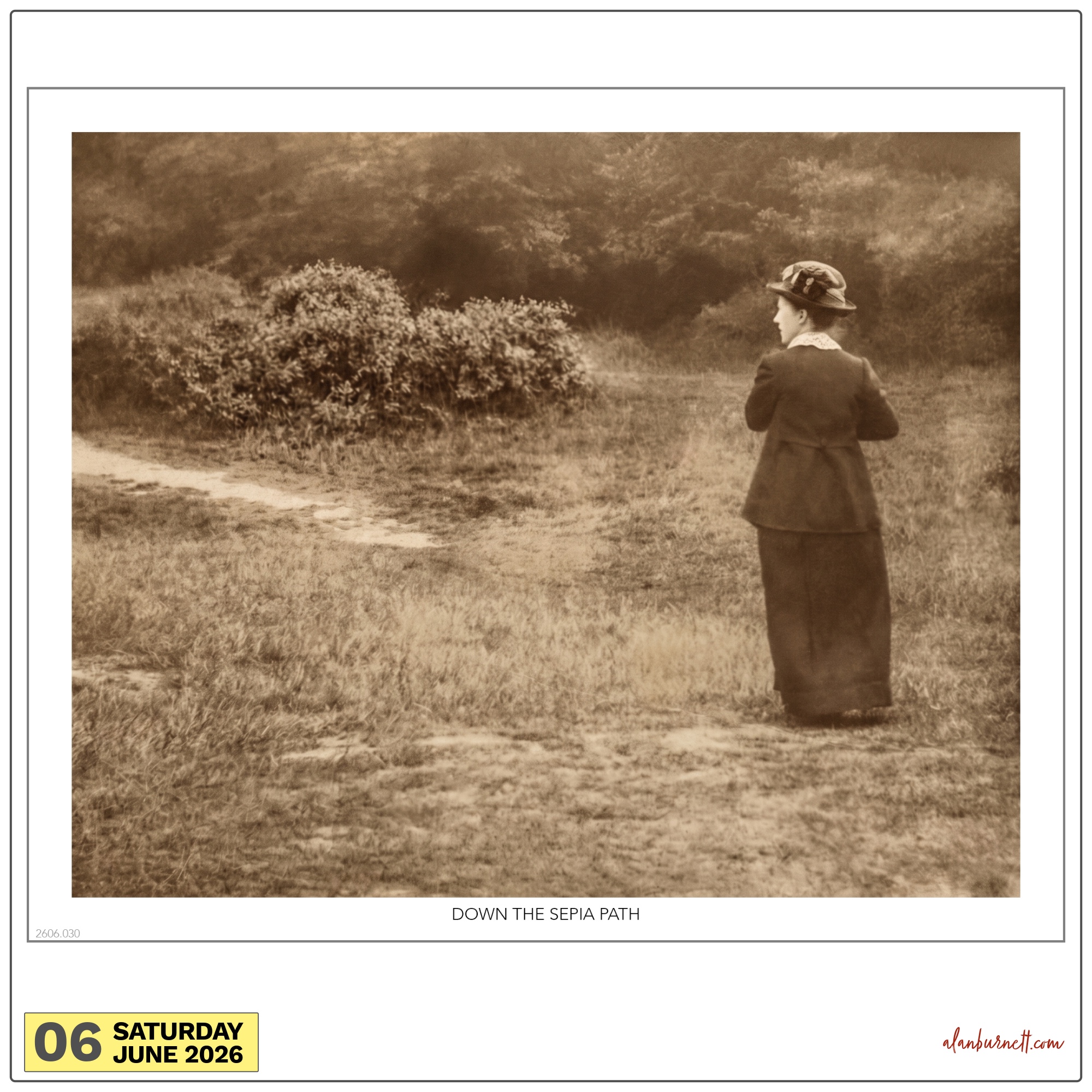
This is an old sepia photograph, taken from one of the many old album pages that litter my room. Many people believe that the sepia colour that characterises photographs from the late nineteenth and early twentieth centuries is the result of fading over time. This isn’t actually the case; sepia toning was specifically introduced to combat the fading that was common in old photographs exposed to light. It later became a fashion statement in its own right, and most Victorian subjects – including this lady – would have preferred the sepia look to black and white.


Looking at the position of her arms I imagine she is holding something as she awaits someone walking towards her. It’s not a child or a handbag, I think, but a cat, That’s the magical power of anonymous old photographs. A single moment in time is preserved motionless for us to wonder at what is going on. And your guess is as good as mine.
I love how such a simple photo like this can have so many different levels of meaning. Art in its composition and tone color, whether intended by the photographer or accidental. History in its time frame and camera technology, even if hidden by forgotten details like name, place or date. And of course, our interpretation as a viewer of the future looking back at the past. Thank you, Alan, for introducing me to so many shades of sepia, gray scale, contrasts of black and white, and the infinite palettes of color, both real and imagined.
LikeLike