

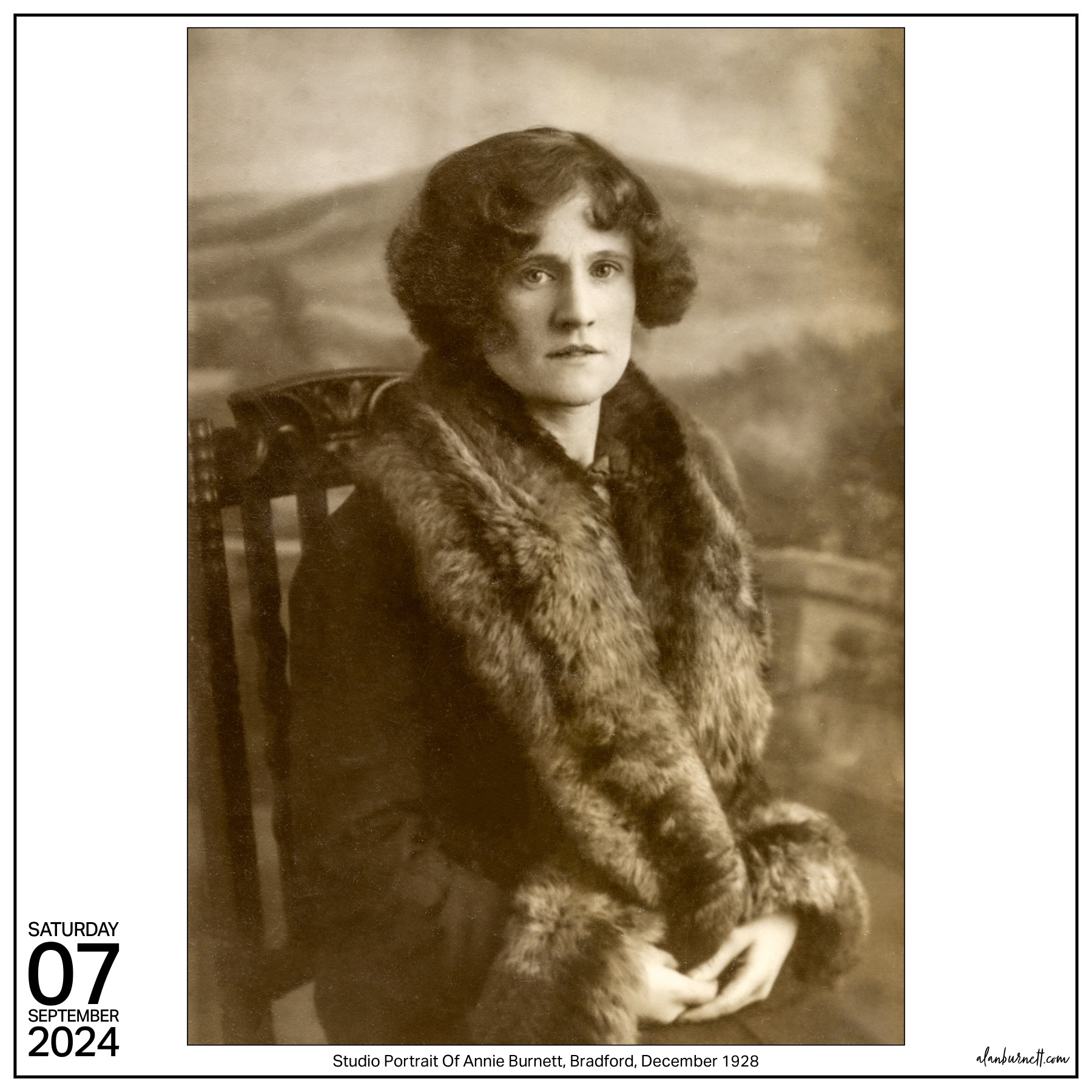
Annie Elizabeth was born in February 1903, the second daughter of my grandparents Enoch and Harriet Burnett. Like all young working class girls born in Bradford at the start of the twentieth century she was destined for the mill – Bradford was regarded as the world centre of the worsted industry – and she will have started mill work during the final years of the Great War . I remember her telling me that during the 1920s she worked at Ickringill’s Mill on Legrams Lane, Bradford. The mill had been established in the late nineteenth century by Ira Ickringill, the nephew of a famous Yorkshire Chartist leader, and it was noted for its progressive attitude towards its workers. Annie worked until she was married in 1933 and by all accounts was an outgoing vivacious girl and something of a local beauty. She sang well and had an infectious sense of humour and was a hit in the many amateur concert parties and theatre groups that existed in Bradford at the time. It was in one such group that she no doubt met her future husband, Harry Moore.
Harry was more than a talented amateur, he was such a successful pianist and vocalist that, for a time in the early thirties, he was able to earn a living as a touring professional entertainer. He worked in a series of travelling professional concert parties, leaving his fiancee Annie Elizabeth back in Bradford whilst he took to the road. But in 1933 they married and Harry abandoned the life of a travelling entertainer and settled down to a job as a clerk in a local coal merchant’s office.
Annie and Harry were married until Annie died in the late 1970s. They never had children and the marriage was continually under the strain of Harry’s weekend work as a pianist in a variety of Bradford Working Men’s Clubs and Annie’s deteriorating mental health. Annie suffered from depression and found it difficult to be at home alone. Harry worked in the clubs every weekend and was away from his home for long periods of time. As a young teenager I became, for a time in the late 1950s and early 1960s, part of the solution to this problem as I would move in and live with Auntie Annie each weekend. Annie got a companion, I got spoilt. And I got told a host of wonderful stories about her childhood and youth.
There were times though when Auntie Annie was suddenly not around – this was the 1950s and 1960s, a time when it was believed that most mental problems could be cured by a brief spell of electroconvulsive therapy in a mental hospital. I was young and I wasn’t aware of what was happening. Nor was I aware of the stories that circulated in the family, accusing Harry of being gay and of abandoning her for weekends of drunken debauchery. By the time I left home and went off to university, Harry was getting old and finding it harder to find work as a pianist. He gave into family pressure and stayed at home. But Annie’s physical health rapidly deteriorated and she spent the final few years of her life in a wheelchair.
In many ways in sounds such a sad life : a life cheated of the promise and excitement you can see in the eyes of that young woman in my photograph. But once we die what remains are memories. And I have such wonderful memories of Annie. Of the times she made me laugh until I cried. Of the nights we sat up late together and watched television shows. Of the joy she felt – a joy that was almost palpable – in the company of me and my friends. When I look back, I see her near the end of her life : a life that had been rather dark and unfulfilled. But I still see that spark in her eyes and that half hidden smile : just as she was on that day in 1928.
 alanburnett.com
Thank you.
LikeLike