
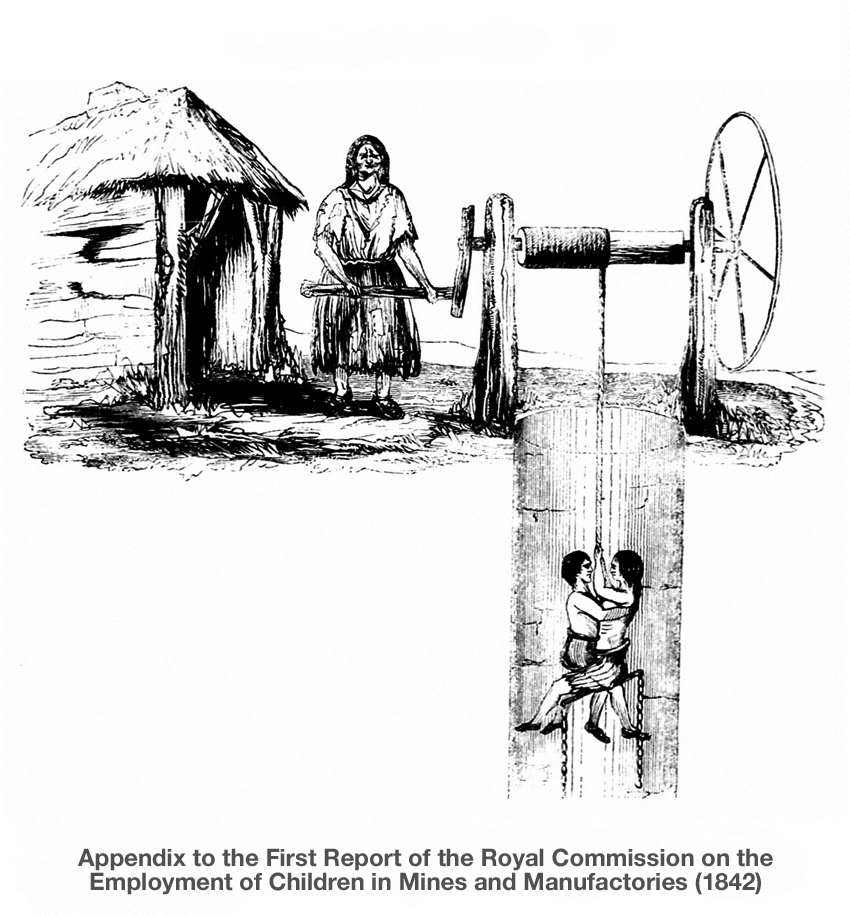
I came across an illustration the other day of two children being hauled up a mineshaft. After a little research I discovered that not only was the illustration a “real” record of two actual named children, but even more surprisingly, it was based on the practices at a coal mine just a few miles away from where I live in West Yorkshire. The illustration was produced as part of the Royal Commission on the Employment of Children in Mines and Manufactories which, in 1842, took evidence from workers and employers in the Halifax area.
The drawing, made by Samuel Scrivan the Chairman of the Royal Commission, was included in the Commission’s published report and it claims to show Ann Ambler and William Dyson being hauled out of Ditchforth and Clays Colliery in Stainland. At the time Ann Ambler was just 13 and William Dyson was 14. Neither the gender nor the age of these children came as any surprise to me – I was well aware that boys and girls as young as six and seven were commonly working in mines at the time – what did surprise me however, was the location of the colliery in question.
When people of my generation think about coal mining in Britain, they tend to think of South Yorkshire or Scotland or South Wales (when those a generation younger than me think about coal mining in Britain they probably think of museums). But coal mining was common to these valleys and hills I call home two hundred years ago. It was not easy coal – no coal is easy in terms of human toil and injury – but it was coal that could be had without the mechanical complexities of twentieth century deep mining. A second chance discovery served to further emphasise this local connection with an energy source that now is imported in great quantities from most of the other corners of the world.

I was browsing through a copy of the Yorkshire Post from June 1921 (I always try to read an old newspaper for each new one I am tempted to open) and I came across this short piece about the rediscovery of coal in Elland (which is within spittoon distance of the Stainland of Ann Ambler and William Dyson). The piece records how the local District Council had made a chance discovery of a remaining seam of coal beneath some land it owned in the town. There was a significant coal shortage at the time and limited emergency stocks were being allocated by the Central Government. Sadly, these wasn’t enough to heat the water for the town’s Public Baths, but the discovery of the seam of coal meant that the baths could re-open. One can only imagine that for the poor devils who were forced to dig underground to release this resource, the re-opening of the public baths was a more of a necessity than a luxury.
 alanburnett.com